In shortAn Osaka cooking class puts you at a hot plate and feeds you what you make. The 2.5-hour okonomiyaki class is held in a local instructor's home by Metro Noda Hanshin station, from $86, with all ingredients, utensils and the meal included. A 2-hour alternative pairs hands-on takoyaki with 10 or more sakes, from $71. Choose by the dish you want to learn.
2.5 hourslength of the okonomiyaki cooking class
from $86price of the okonomiyaki class
from $71takoyaki cooking with sake tasting
5.0 ★ (313)rating of the okonomiyaki class
What an Osaka cooking class actually involves
You cook at a hot plate or a teppan counter with the ingredients already set out and the tools on the table. In the 2.5-hour class the kitchen is a local instructor's home in Noda, so it is a domestic griddle, a sink and a table rather than a stage with a camera over it. All ingredients and utensils are included, the instruction is in English according to the listing, and the lunch or dinner you sit down to afterwards is the food you cooked. If you would rather pair the griddle with a walk, one food tour in Osaka on this site, the Shinsekai to Dotonbori walk, ends with an okonomiyaki lesson at a teppan in a Dotonbori restaurant.
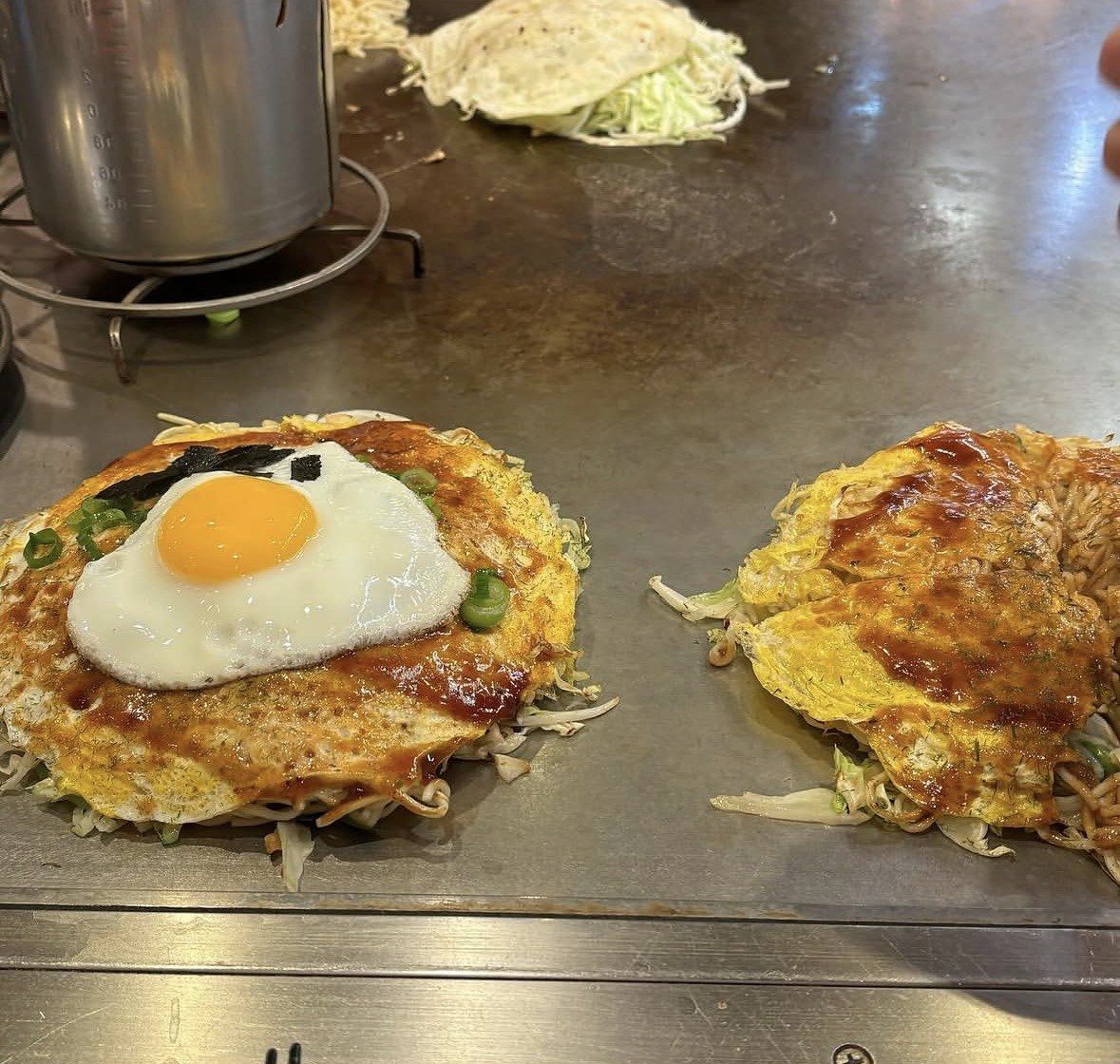
The hands-on part is short and physical. For the Osaka pancake you dissolve wheat flour in dashi, a kelp and bonito stock, fold in the cabbage that the tourism bureau calls the essential ingredient, spread the mix flat and round on the hot plate and lay pork on top before turning it. The octopus-ball session is fiddlier: batter goes into a moulded plate and each ball gets turned until it is round.
Not every class format includes shopping. Longer four-hour classes in the city add a market walk before the cooking and run through three dishes, okonomiyaki, gyoza (pan-fried dumplings) and niku-sui, a meat and broth soup. The two sessions on this site are shorter and entirely seated, at 2 hours and 2.5 hours, which is why they slot around a half-day of walking rather than replacing it.
- Okonomiyaki class, 2.5 hours: ingredients, utensils, English-speaking instructor and the lunch or dinner you cook
- Takoyaki and sake session, 2 hours: ingredients and tools, the takoyaki you make, 10 or more Japanese sakes to choose from, legal adults only
- Both are indoor and seated, with a fixed start time rather than the shop-by-shop hours that govern Dotonbori and Kuromon Ichiba
The okonomiyaki class in Noda
2.5 hours in a local instructor's home with all ingredients and utensils, an English-speaking instructor and the lunch or dinner you cooked, from $86, rated 5.0 ★ (313 reviews).
★ 5.0/5 · 313 reviews
Choosing between the griddle, the octopus balls and the market-walk format
Pick by the dish you want in your hands. If it is the cabbage pancake, take the 2.5-hour class from $86, rated 5.0 ★ (313 reviews), which is the only option here where you cook a full meal and eat it at a table. If it is takoyaki and you want something to drink with it, the 2-hour session from $71, rated 5.0 ★ (167 reviews), gives you the batter plate plus a choice of 10 or more sakes, with the drinks side open to legal adults only.
The market-walk-plus-several-dishes format is the long version of the same idea, running four hours and covering three dishes after a walk through a food market. It is the one to look for if shopping for the ingredients matters as much as cooking them, and it is the heaviest time commitment of the three formats.
A private walk is the answer for anyone who wants the dishes without the cooking: 3 hours, 8 tastings balanced between sweet and savoury, an online personalisation form after booking and direct contact with the host, from $184. No vehicle is included, and it starts either with a pick-up on foot at a centrally located Osaka hotel or at a central Starbucks Coffee meeting point. Which dates the host has open, and the conditions attached to them, sit on that walk's booking page.
| Session | Duration | From | Rating | Hands-on cooking | Meeting point | Best for |
|---|
| Osaka Cooking Class: Okonomiyaki and Japanese Cuisines Experience | 2.5 hours | from $86 | 5.0 ★ (313) | Yes, full class in an instructor's home | Garden area in front of Vie De France, Metro Noda Hanshin Exit 4 | Taking the Osaka pancake method home; families who want a table |
|---|
| Osaka Sake Tasting & Hands-On Takoyaki Cooking | 2 hours | from $71 | 5.0 ★ (167) | Yes, the takoyaki you make | MOMO to SAKE, second floor | Drink-led travellers; 10 or more sakes, legal adults only |
|---|
| Osaka Private Food Tours by Local Foodies: 100% Personalized | 3 hours | from $184 | 5.0 ★ (21) | No, 8 tastings on a private walk | Hotel pick-up on foot in central Osaka, or a central Starbucks Coffee | A tailored list of dishes, with no cooking involved |
|---|
Learn to make okonomiyaki the Osaka way
Kansai okonomiyaki is mixed before it hits the plate. Flour is dissolved in dashi, cabbage goes through the batter rather than on top of it, the whole thing is spread flat and round on the griddle, and pork is the popular topping. The Hiroshima version is assembled instead of stirred, and it is not what you will be taught at an Osaka plate: a thin batter crepe goes down first, then cabbage, bean sprouts and green onion steamed on top of it, then soba noodles, then sauce and nori. A Japanese cooking class in Osaka teaches the mixed method, which is the one you can repeat on a frying pan at home.
What you are paying for in the 2.5-hour class is repetition with someone watching: the batter consistency, how much cabbage the mix will carry, when to turn and when to leave it alone. The home-kitchen setting keeps the group at a table and the dish within reach, and the meal at the end is a sit-down lunch or dinner rather than a plate eaten standing up.
Meet at the garden area in front of the Vie De France bakery, directly outside Exit 4 of Metro Noda Hanshin station, which is also the Hanshin railway Noda station. Type the Hanshin station into your map app, because JR Noda is a separate station roughly 10 minutes away on foot and that is where people go wrong.
Takoyaki with a sake tasting in one seated session
The 2-hour session is the shorter cooking class in Osaka and the easier one to fit into an afternoon. Ingredients and tools to make takoyaki are provided, you eat the batch you turn out, and the tasting runs to 10 or more varieties of Japanese sake you choose from yourself. The room is a second-floor space called MOMO to SAKE, so put that shop name into your map app rather than hunting for a sign at street level. The sake part is for legal adults only.
Takoyaki is a recent dish, which makes the technique less mysterious than it looks. Aizuya, credited with inventing it, opened in Osaka in 1933 under first-generation owner Tomekichi Endo, and the shop's own history puts the dish at 1935; the version that came before it was radioyaki, filled with konjac and beef instead of octopus, and it is still on sale. According to the tourism bureau, shops selling it only multiplied across Osaka in the 1950s, so the method you practise at the plate had barely settled when your grandparents were young.
Sixty seconds of vocabulary helps at the tasting table. Seimai buai is the share of the rice grain left after polishing, so ginjo means 60% or less and daiginjo 50% or less, while junmai is rice, rice koji and water with nothing added. The brewers' association gives three serving bands: chilled at 8 to 15C, room temperature at 15 to 25C and warmed at 40 to 50C. Warmed suits a January afternoon, when Osaka's normal daily minimum is 3.0C; in August, with a monthly mean of 29.0C, order from the chilled band.
When a class works better than a street walk
Weather is the clearest reason to cook indoors. Rain is the first half of it: the 1991 to 2020 normals put June at 185.1 mm, higher than any other month, with July on 174.4 mm and September on 152.8 mm, and the Kinki rainy season normally sets in around 6 June and lifts around 19 July. Heat is the other half: August averages 29.0C for the month with a normal daily maximum of 33.7C, and humidity peaks at 70% in July. A griddle under a roof is the sensible slot in those weeks.
With children, a class gives everyone a job and a seat. There is mixing, pouring and turning, a plate at the end, and a fixed start time instead of a schedule built on arcades and shops that set their own opening hours and closing days. For families, the okonomiyaki class is the one to book, since the drinks side of the takoyaki session is restricted to legal adults.
The third reason is the skill. You come away able to make the dish again, which is worth more than another photograph of the canal. Book early around the dates when the city fills up: Golden Week on 29 April and 3, 4 and 5 May, Tenjin Matsuri on 24 and 25 July, and the mid-September holiday runs.
What to wear and what to bring
Dress for a hot plate at close range. Sauce spits, and the smell of grilling cabbage and pork settles into whatever you are wearing, so leave the shirt you want for dinner at the hotel. One of the two sessions takes place in somebody's home, which means shoes off at the door and socks you are happy to be seen in.
Tell the operator about allergies or dietary needs when you book rather than on the day. Standard Osaka batter is dissolved in dashi and pork is the usual topping, so the default dish is not vegetarian, and Japan's national tourism organisation warns vegans that bonito flakes can be in a dish with no fish visible. For questions about one specific ingredient, the Osaka Convention and Tourism Bureau takes calls on 06-6131-4550, daily from 9:00 to 17:30.
- Clothes and a hair tie you do not mind smelling of griddle smoke; closed, comfortable shoes
- Cash, which is still the easier option around the food districts
- Your dietary notes, sent to the operator at the time of booking
- Nothing for tips: tipping is not customary in Japan, including on food tours and classes, in restaurants and in taxis
- No cigarette or vape for the walk to the meeting point. The ban covers all of Osaka City, in force since 27 January 2025 anywhere outside a designated smoking area, and the penalty is a 1,000 yen fine
Questions people ask
Is the instruction in English?
The okonomiyaki class listing includes an English-speaking instructor, so the method is explained step by step as you cook. The takoyaki and sake session is a seated format with the ingredients and tools laid out for you. Language details and other conditions are shown on the booking page.
Do I need to bring ingredients, an apron or any equipment?
No. Both sessions list the ingredients and the tools as included, and the okonomiyaki class also includes the lunch or dinner you cook. Bring cash for anything you buy afterwards and leave the shopping to the class.
Can I fit a cooking class and a tasting walk into the same day?
Yes, comfortably. The classes run 2 hours and 2.5 hours, which leaves either side of the day open, and the private walk is 3 hours with 8 tastings. One cooking session plus one walk is a realistic day; two batter sessions back to back is a lot of batter.
Which one suits a rainy or very hot afternoon?
Either class, since both are indoors and seated. Rain and heat are where that pays off: June tops the normals at 185.1 mm, and the standard August daily high is 33.7C. The takoyaki and sake session is the shorter of the two at 2 hours.
Is a class better value than a guided walk?
They buy different things. A class buys a technique you keep, a seat and a meal you cooked; a guided walk buys access and ordering at counters you would not pick alone. If you only have one food slot in Osaka and want a skill out of it, cook.
Read also